Welcome to Bytecoding, your coding school for mastering HTML, CSS, JavaScript, and Python. At Bytecoding, we emphasize the practical applications of these essential languages. HTML forms the structure, CSS styles the presentation, and JavaScript adds interactivity to web pages. This transformative journey involves hands-on experiences, where you sculpt code to optimize user interfaces and enhance user experiences. Understanding these languages is not just about syntax; it's about practical skills that empower you to navigate GitHub, collaborate on projects, and participate effectively in the dynamic realm of software development. Join Bytecoding, where proficiency in HTML, CSS, JavaScript, and Python unlocks the doors to innovative and collaborative possibilities.
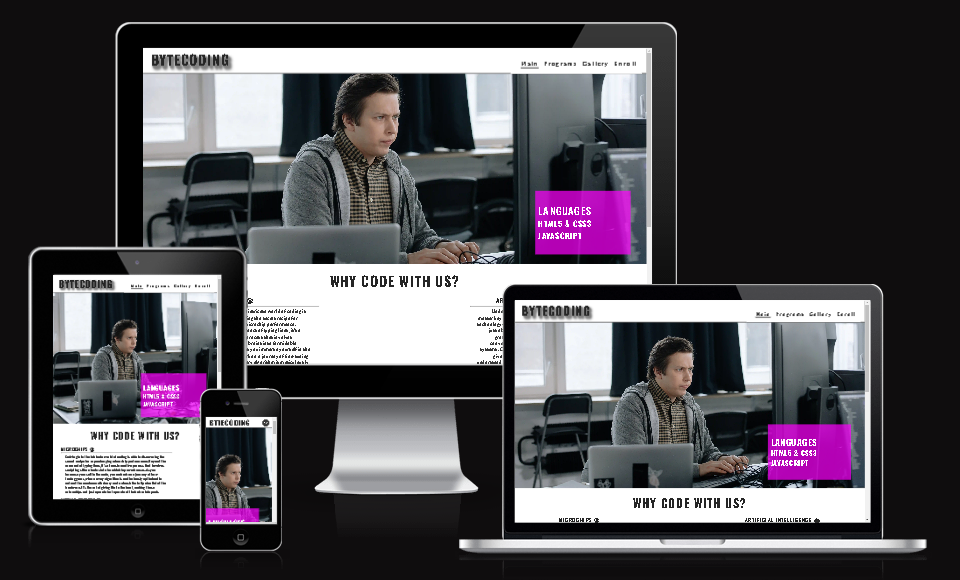
In our project, we've integrated key features to cater to the needs of our users. The website primarily targets aspiring web developers, offering a comprehensive learning experience. Our programs at ByteCoding encompass HTML5, CSS, JavaScript, and Python, providing a comprehensive education in web development. Starting with HTML, learners gain foundational skills essential for creating and managing digital content. The HTML program emphasizes hands-on exercises, ensuring practical application and understanding of web standards, accessibility, and responsive design. CSS instruction follows, enabling students to transform static content into visually engaging web pages. Emphasizing selectors, properties, and responsive design, CSS learners acquire skills for aesthetically pleasing and user-friendly interfaces. The JavaScript program is dynamic, focusing on interactivity, DOM manipulation, and creating dynamic web content. Learners progress from basic syntax to advanced concepts, including popular frameworks, preparing them for diverse web development roles. Lastly, the Python program introduces students to programming through a language known for simplicity and readability. Covering basics, functions, and advanced topics, Python instruction equips learners with versatile skills applicable in web development, data analysis, and beyond. Practical exercises foster problem-solving abilities, making ByteCoding the ideal platform for individuals seeking hands-on proficiency in these essential programming languages.
-
Navigation Bar
-
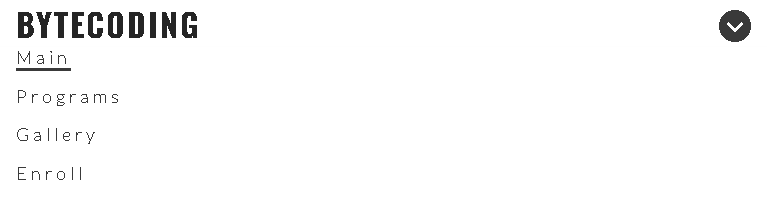
Consistently showcased on all four pages, the entirely responsive navigation bar features links to the Main page, Programs page, Gallery page, and Enroll page, guaranteeing seamless navigation across the entire site.
-
This functionality allows users to effortlessly move between pages on any device, eliminating the necessity of depending on the 'back' button to revert to the prior page.
-
-
The landing page image
-
On the main page, the image showcases the immersive programming environment that awaits students.
-
The magenta background offers a high-contrast backdrop for the cover text on the main page image, enhancing readability.
-

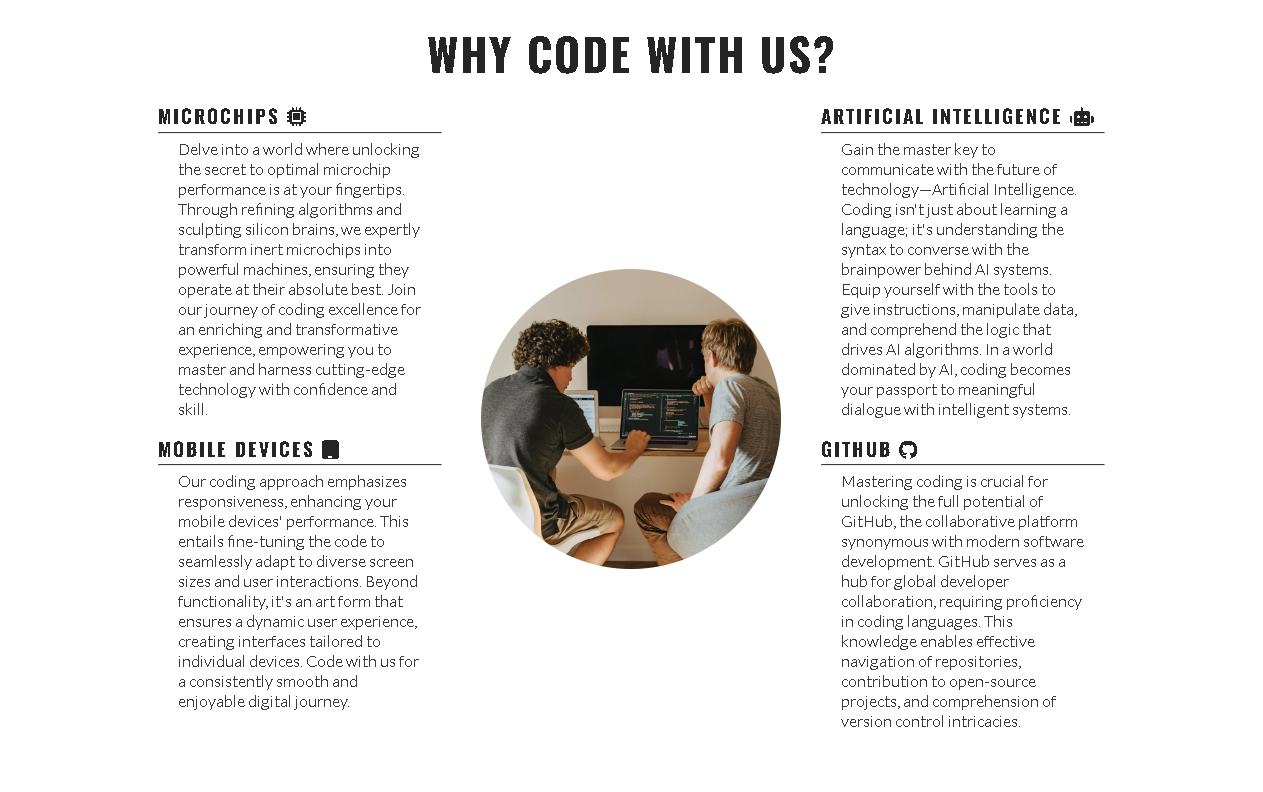
- Bytecoding Why Code With Us?
- Discover compelling reasons to choose Bytecoding on the main page, including microchips, mobile devices, artificial intelligence, and github.
-
Bytecoding Programs
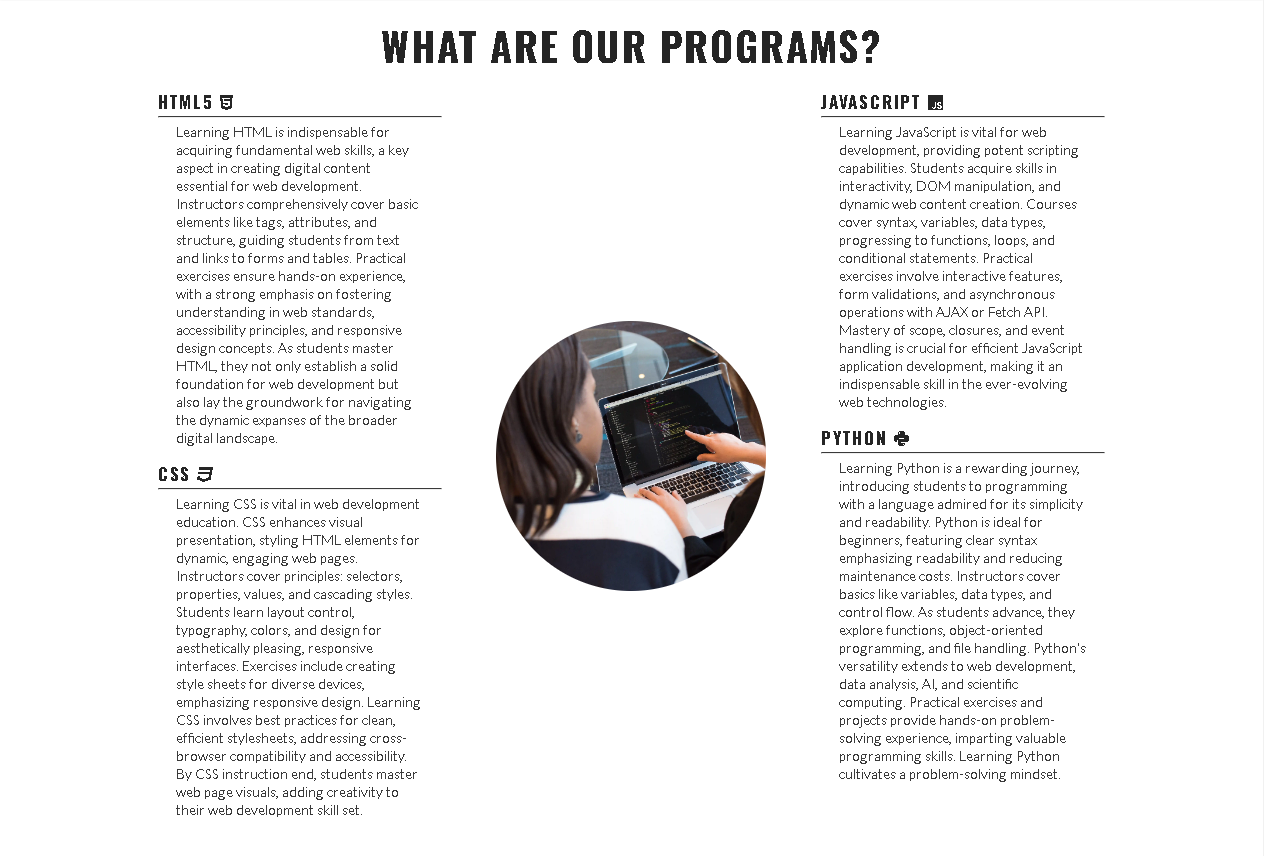
- The Program section of the Bytecoding website offers insights into various programming languages, including HTML, CSS, JavaScript, and Python. Each language is explored to provide students with a comprehensive understanding of its functionalities and applications. Whether delving into the structure of web pages with HTML, enhancing styling with CSS, implementing dynamic behavior with JavaScript, or delving into versatile scripting with Python, Bytecoding's program section serves as a valuable resource of knowledge across a spectrum of programming disciplines.
-
Bytecoding Schedules
- At the bottom of the programs page, visitors can find a convenient display showcasing the current time schedules. This feature is designed to provide users with up-to-date information on program timings, allowing them to plan their engagements and make the most of the available learning opportunities.

-
The Footer
-
In the footer section, Bytecoding offers a convenient compilation of relevant platforms that students are encouraged to utilize for enhanced engagement and connectivity.
-
These platforms include Facebook, Git, Instagram, Skype, Telegram, Twitter, WhatsApp, and YouTube.
-
They open in new browser windows, guaranteeing that the Bytecoding website itself stays accessible.
-
All the footer icons were manually colored using hexadecimal notation in the CSS stylesheet code.
-

-
Gallery
- The gallery displays students actively engaging with the diverse Bytecoding programs.

-
The Enroll Page
- The Enroll page facilitates registration at Bytecoding, enabling individuals to embark on their coding journey. Users can indicate their coding preference among HTML, Javascript, and Python. Additionally, they will be prompted to provide their full name and email address during the enrollment process.

- The website could greatly benefit from the integration of video content and JavaScript animations to enhance user engagement and visual appeal. Video content can convey messages effectively. Additionally, JavaScript animations can bring a sense of interactivity and liveliness to the site. From subtle transitions to more elaborate effects, well-executed animations can capture users' attention and create a more enjoyable browsing experience.
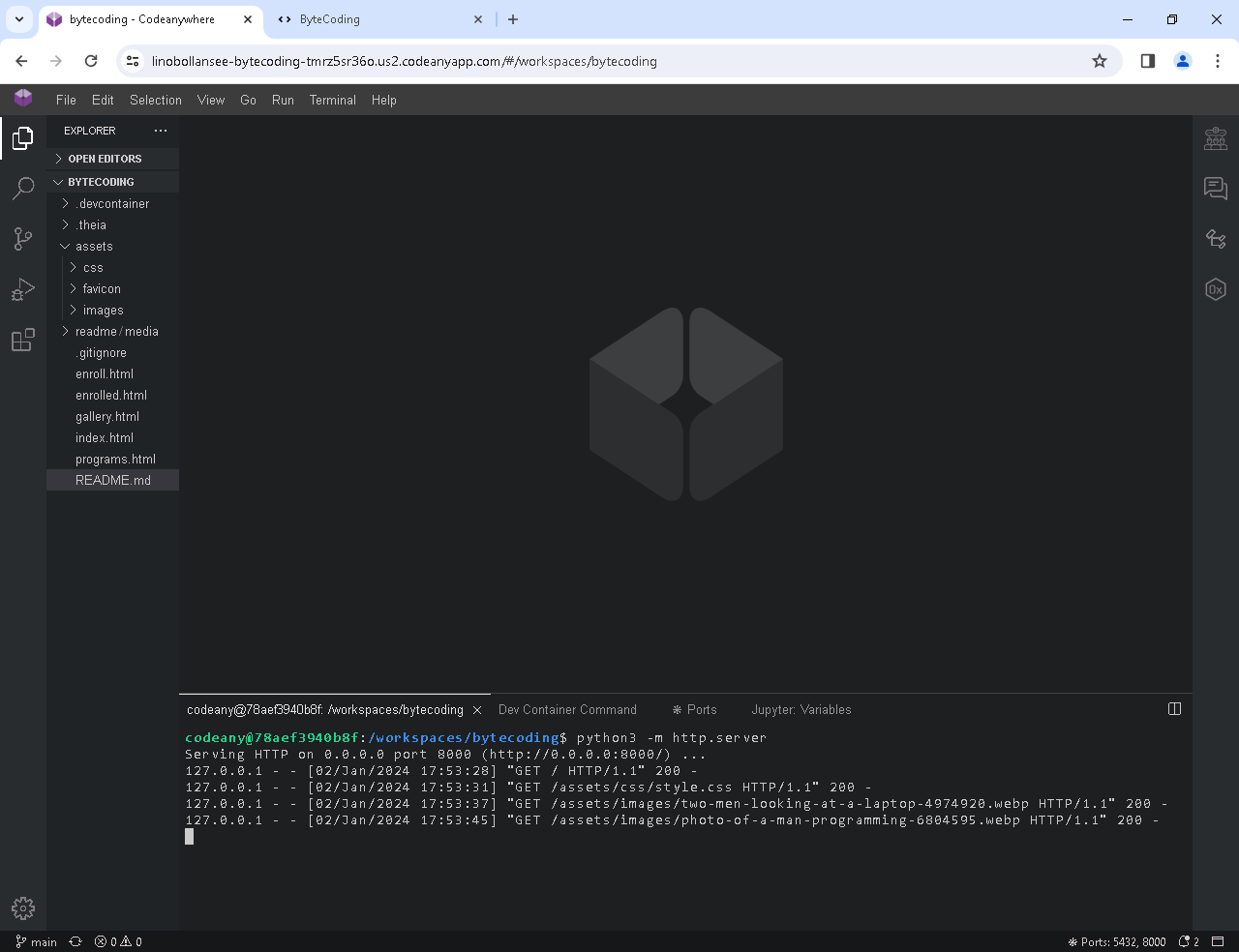
- To test the Bytecoding website on the cloud-based Integrated Development Environment (IDE) Codeanywhere, the command "python3 -m http.server" was employed in the terminal window. This command initiated a simple HTTP server using Python version 3. By executing this command, the HTTP server started, allowing for easy access to the site through a web browser. This method of testing provided a quick and convenient way to preview the Bytecoding site in a web environment, ensuring that it functioned correctly and allowing for real-time evaluation of its appearance and functionality.
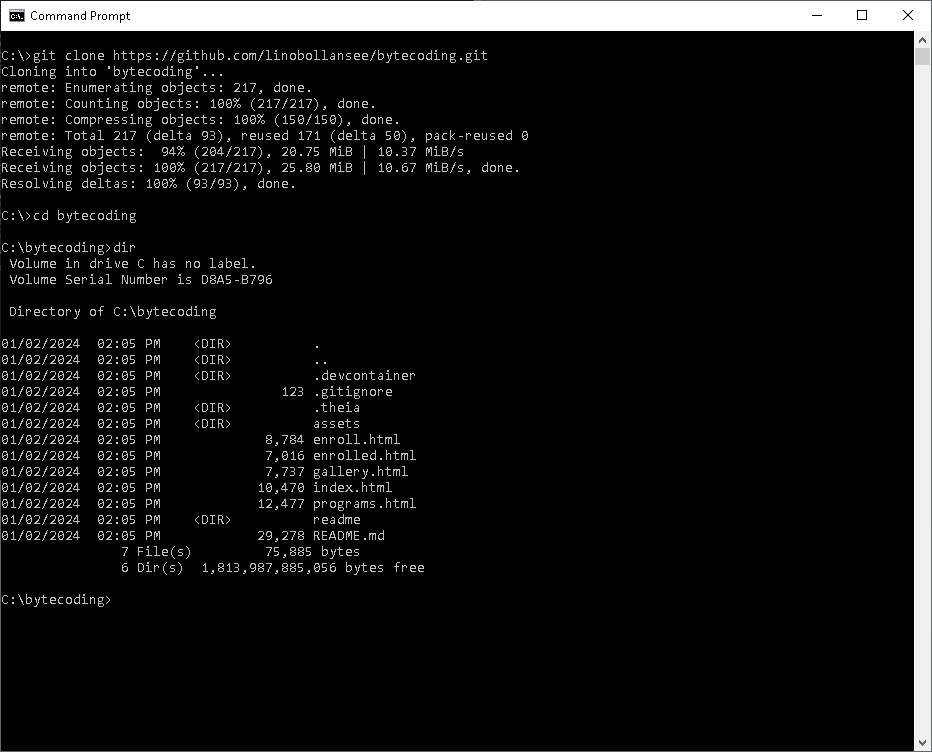
- Alternatively, the Bytecoding website was tested in a web browser by utilizing local copies of the website files. The repository was first cloned using the "git clone https://github.com/linobollansee/bytecoding.git" command in a Command Prompt window. Testing with this method is less preferred as it doesn't guarantee that the online version will function exactly as desired. The local testing method doesn't provide a comprehensive assessment of how the website will perform in its intended online environment. Therefore, it is recommended to combine local testing with online testing to ensure the website functions optimally in both settings.
-
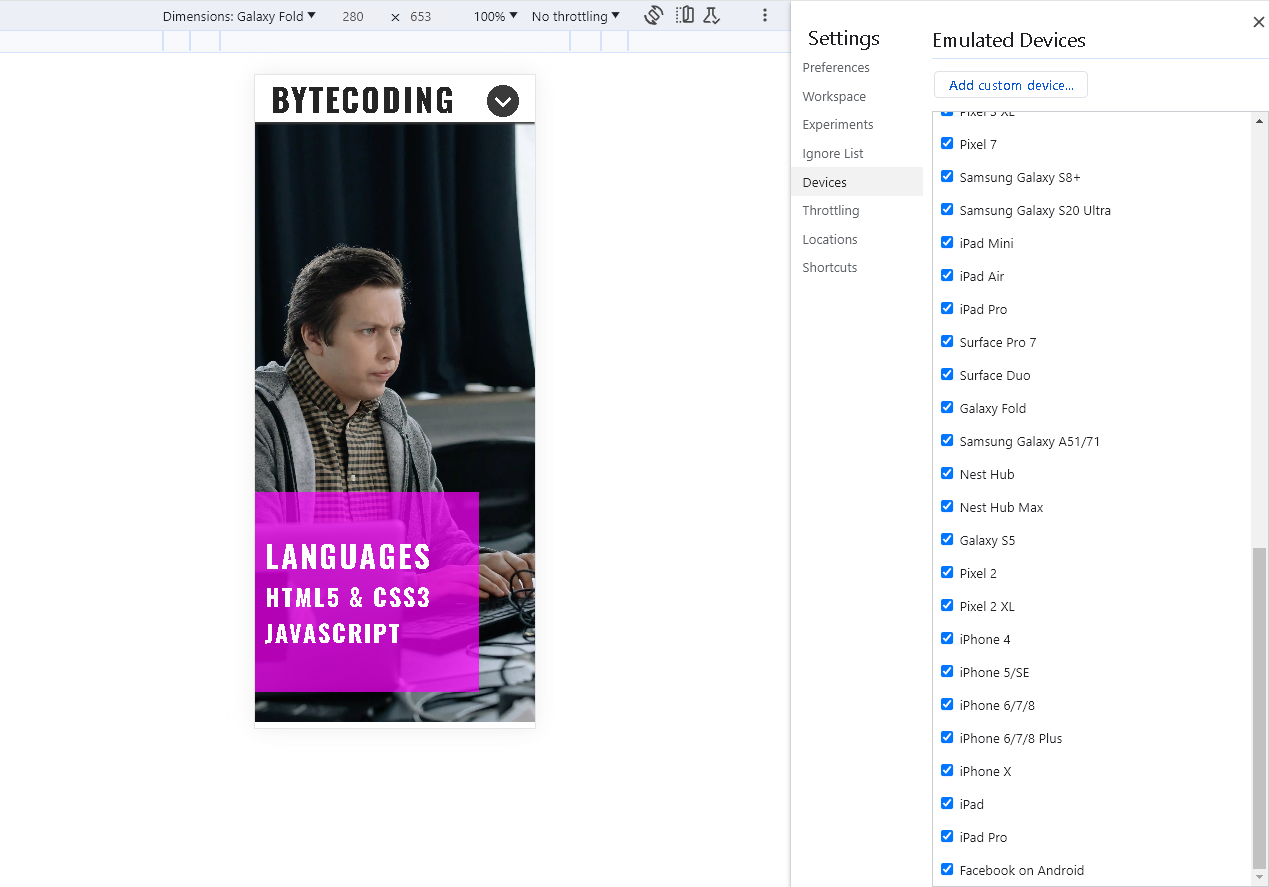
The website underwent comprehensive testing using Google Chrome DevTools to ensure optimal performance across various devices. Employing this versatile tool allowed for the simulation of diverse device environments, including smartphones, tablets, and desktops. By emulating different screen sizes, resolutions, and user agent settings, the testing process aimed to identify and address any potential layout or functionality issues that might arise on distinct devices.
-
Although low-resolution devices may not allow for the full display of the main page image, it still maintains an aesthetically pleasing appearance, and the menu remains user-friendly.
- The Bytecoding website underwent a comprehensive evaluation using Google Lighthouse, a powerful and versatile web performance auditing tool. The testing encompassed key aspects such as performance, accessibility, progressive web app (PWA) compliance, SEO, and general best practices.

- A checklist of simple tests was written and completed to make sure the functionalities of the website and repository function as intended.
- Testing website Bytecoding PASSED
- Testing main page link on every page Bytecoding Main Page PASSED
- Testing programs page link on every page Bytecoding Programs Page PASSED
- Testing gallery page link on every page Bytecoding Gallery Page PASSED
- Testing enroll page link on every page Bytecoding Enroll Page PASSED
- Testing enrolled page link Bytecoding Enrolled Page PASSED
- Testing submitting form on Bytecoding Enroll Page PASSED
- Testing submitting incomplete form to test
requiredHTML attribute on Bytecoding Enroll Page PASSED
- Testing enrolled page Bytecoding Enrolled Page PASSED
- Testing enrolled page link to return to the main page Return to Main Page PASSED
- Testing footer link Facebook PASSED
- Testing footer link Git PASSED
- Testing footer link LinkedIn PASSED
- Testing footer link Skype PASSED
- Testing footer link Telegram PASSED
- Testing footer link Twitter PASSED
- Testing footer link WhatsApp PASSED
- Testing footer link YouTube PASSED
- Testing website on 576 pixels width or higher PASSED
- Testing website on 768 pixels width or higher PASSED
- Testing website on 1200 pixels width or higher PASSED
- Testing Favicon Apple-Touch PASSED
- Testing Favicon 32x32 PASSED
- Testing Favicon 16x16 PASSED
- Testing Style CSS PASSED
- Testing README.md PASSED
-
HTML
- No errors were detected when testing with the official W3C validator
- https://validator.w3.org/nu/?doc=https%3A%2F%2Flinobollansee.github.io%2Fbytecoding%2Findex.html
- https://validator.w3.org/nu/?doc=https%3A%2F%2Flinobollansee.github.io%2Fbytecoding%2Fprograms.html
- https://validator.w3.org/nu/?doc=https%3A%2F%2Flinobollansee.github.io%2Fbytecoding%2Fgallery.html
- https://validator.w3.org/nu/?doc=https%3A%2F%2Flinobollansee.github.io%2Fbytecoding%2Fenroll.html
- https://validator.w3.org/nu/?doc=https%3A%2F%2Flinobollansee.github.io%2Fbytecoding%2Fenrolled.html
-
CSS
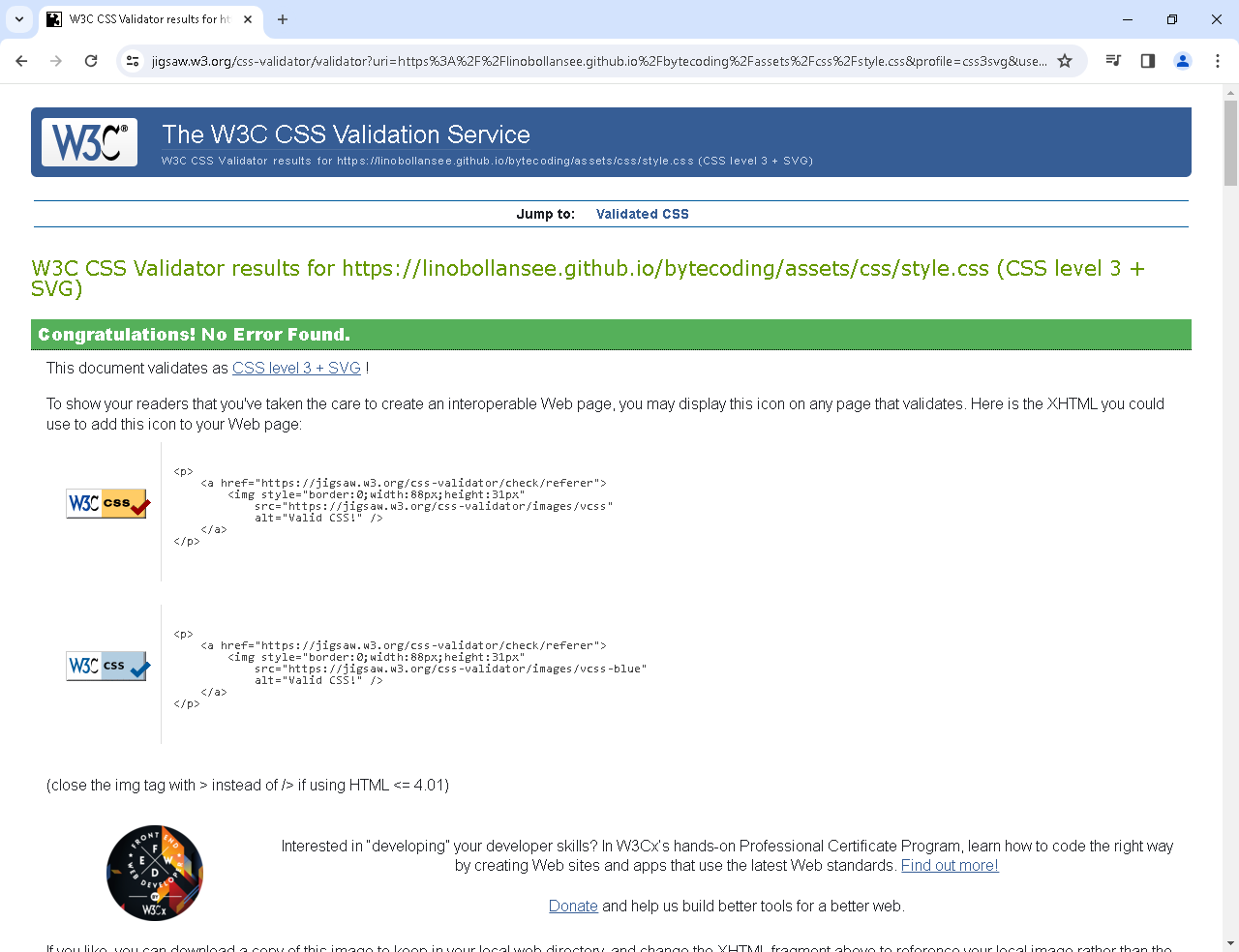
- No errors were detected when testing with the official (Jigsaw) validator
- No errors were detected when testing with the official (Jigsaw) validator
Upon inspection, the code seems to be devoid of any bugs, indicating a solid foundation. However, the prospect of enhancing its efficiency remains open. There exists the possibility of optimization by scrutinizing and potentially adding, modifying, and eliminating lines from the Love Running project template.
-
Issue: Codeanywhere Outage
- Problem Identified: Recognized a critical outage of the cloud-based IDE, Codeanywhere, causing a disruption in the development workflow.
- Solution Implemented: Established a temporary local development environment using Visual Studio Code.
-
Issue: Uncertainty regarding the re-establishment of IDE Codeanywhere
- Problem Identified: Initiating the Codeanywhere IDE requires an exceptionally extended duration, raising significant uncertainty about its proper functionality.
- Solution Implemented: Conducting tests by editing the README.md, as advised by Student Care, to verify regular functionality.
-
Issue: Monotonous logo
- Problem Identified: Identified a lack of visual appeal in the logo, contributing to a monotonous appearance.
- Solution Implemented: Employed CSS text-shadow syntax to enhance and elevate the visual presentation, adding a touch of style to the logo.
-
Issue: Incorrect LinkedIn URL
- Problem Identified: Clicking the LinkedIn icon failed to redirect the website visitor to the LinkedIn website via the provided URL address.
- Solution Implemented: The URL address was corrected on all of the pages.
-
Issue: Favicon directory misnamed
- Problem Identified: The favicon directory was inadvertently misnamed to its plural form, "favicons," rendering it impossible for the website to load the favicon.
- Solution Implemented: The directory was renamed and the changes committed and pushed to the git repository.
-
Issue: Wrong file names in the Love Running Template
- Problem Identified: The web images present in the HTML and CSS code of the Love Running template are not intended for use on the Bytecoding website.
- Solution Implemented: Substituting Bytecoding code and images after removing unnecessary code during the editing process.
-
Issue: Website text content unsophisticated
- Problem Identified: Writing about specific content becomes challenging without years of experience.
- Solution Implemented: Iteratively questioning ChatGPT in anticipation of obtaining potentially omitted information and meticulously validating the information before incorporating it into the website.
-
Issue: Google Lighthouse low performance score
- Problem Identified: Long loading times are attributed to images in an outdated JPG format and insufficient compression.
- Solution Implemented: Employing the current webp format and exploring compression ratios to achieve a meticulous balance between presentation and performance.
-
Issue: Unappealing text alignment
- Problem Identified: The CSS text-align property of the Love Running template was unappropriate for the Bytecoding website.
- Solution Implemented: The line of code was removed to align the text differently.
-
Issue: Outdated README.md templates mention the GitHub "main branch" as the formerly used "master branch", which is now considered deprecated.
- Problem Identified: Student Lino Bollansee noticed discrepancies when examining examples. Mentor Dick Vlaanderen conclusively raised awareness of the "main branch" name change, advising the consistent use of up-to-date terminology.
- Solution Implemented: Henceforth, within all README.md documentation, the default branch name of a GitHub repository is denoted as the "main branch".
-
Issue: Challenge of recalling all issues that transpired throughout the project.
- Problem Identified: The Code Institute advises comprehensive documentation of the project's issues in the README.md. This leads to the realization that recalling everything will be challenging.
- Solution Implemented: The commit history was revisited to directly identify and address corrected issues, as well as to stimulate consideration of challenges resolved outside of any commit history for improved documentation.
-
Issue: README.md contains assets links
- Problem Identified: Just prior to project submission, a checklist warned against the presence of file link references to the assets directory in the README.md.
- Solution Implemented: Removed all links pointing directly to the assets directory, and substituted some with PNG image screenshots.
Final Remark: This compilation of Issues is NOT considered exhaustive; in reality, the Issues seemed almost limitless, involving many computer restarts!
- Deployment to GitHub Pages was completed for the site. The deployment process involves the following steps:
- Within the GitHub repository, access the Settings tab.
- Choose the Pages tab, set the "main branch" from the dropdown menu in the source section.
- After selecting the "main branch", the page will automatically refresh, displaying a detailed ribbon to confirm the successful deployment.
You can access the live link at this location. - https://linobollansee.github.io/bytecoding/
-
Code Institute: Learning Management System
- The development of the Bytecoding website has been greatly enriched by the invaluable lessons emanating from the Code Institute LMS (Learning Management System). Drawing upon the extensive knowledge and expertise available on the Code Institute's learning platform, the advice received has played a pivotal role in shaping the design, functionality, and overall user experience. From best practices in web development and coding techniques to insights on user engagement and accessibility.
-
Code Institute: Love Running project
- The creation of the Bytecoding website was enriched by incorporating HTML and CSS, in particular for the responsiveness on different devices, from the Love Running project sourced from the Code Institute's repository at GitHub. Leveraging the Love Running project provided valuable insights, functionalities, and design components that contributed to the overall development and enhancement.
-
Code Institute: Readme Template
- The creation of the README.md file was facilitated through the utilization of the Code Institute's README.md template. Leveraging this template provided a structured and comprehensive framework for documenting the project. By aligning with the Code Institute's recommended format, the README.md file not only adheres to best practices but also ensures clarity and consistency in conveying essential information about the project.
-
Code Institute: Slack community
- The Slack community of the Code Institute deserves recognition for providing a rich pool of knowledge on project approach and conceptualization. Members actively contribute by sharing their own projects and files, adding substantial value to the collective learning experience.
-
Code Institute: Student Support: Mentor Guidance
- The Code Institute provided three sessions with mentor Dick Vlaanderen whose experience and guidance helped refine and verify the website's presentation and functionality aspects, contributing to the overall success of the project.
-
- The text content on the Bytecoding website and its README.md owes much to the collaborative efforts of Lino Bollansee and OpenAI's ChatGPT 3.5. Lino Bollansee's distinctive insights, expertise, and writing style provided the initial groundwork for the content. Subsequently, ChatGPT was utilized to refine the material, utilizing its language generation capabilities to enhance structure, ensure coherence, and elevate the overall writing quality.
-
- The cascading style sheets (CSS) syntax employed in creating the visual presentation of the Bytecoding logo has been sourced from the reputable and educational platform, W3Schools.
- CSS Shadow Effects
-
- Codeanywhere's cloud-based development environment played a pivotal role in the creation of the Bytecoding website by offering a flexible and collaborative platform for coding. Codeanywhere was utilized to seamlessly write, edit, and run code directly from a web browser, eliminating the need for a dedicated local development environment.
-
- During routine planned maintenance at Codeanywhere, the online cloud-based integrated development environment experienced a temporary unavailability. In response to this situation, an offline alternative was found: Visual Studio Code. This ensured uninterrupted workflow, allowing work to proceed without any disruption.
-
- GitHub serves as a robust hosting platform for the Bytecoding website, offering a centralized repository and comprehensive version control features. The website's source code is securely stored on GitHub, providing a space where developers can easily manage changes, track revisions, and coordinate efforts. The platform's web hosting functionality ensures that the Bytecoding website is easily accessible to users globally.
-
- The captivating visuals featured on the Bytecoding website have been sourced from the reputable and high-quality stock photography website, Pexels.com. By leveraging the diverse and visually stunning images available on Pexels, this content aims to enhance the overall user experience, providing a visually appealing and engaging environment. Pexels is renowned for offering a vast collection of royalty-free images contributed by talented photographers, making it a valuable resource for content creators seeking professional and aesthetically pleasing visuals. The inclusion of images from Pexels not only adds visual richness to the content but also upholds a commitment to utilizing resources that adhere to ethical and legal standards in the realm of digital media.
-
- The typography on the Bytecoding website been selected from the vast array of fonts offered by Google Fonts, a renowned and user-friendly font library. By leveraging Google Fonts, the website benefits from a typefaces that not only enhance the visual appeal but also contribute to a seamless and legible reading experience.
- Lato Google Font
- Oswald Google Font
-
- The vibrant and visually appealing icons adorning the Bytecoding website have been meticulously curated and sourced from Font Awesome, a renowned and comprehensive icon library. Font Awesome, known for its extensive collection of scalable vector icons that can be customized effortlessly, provides a rich resource for web designers and developers. By integrating Font Awesome icons, a seamless blend of aesthetics and functionality is achieved, enhancing the user experience with intuitive and recognizable symbols.
- circle-chevron-down
- microchip
- tablet
- robot
- github
- git
- skype
- telegram
- square-x-twitter
- square-youtube
- html5
- css3
- js
- python
-
- The captivating favicons gracing the Bytecoding website were generated using the efficient and user-friendly online tool, Favicon.io's Favicon Converter. Leveraging the Favicon Converter, the distinctive favicons were effortlessly created to ensure a visually appealing and recognizable representation across various browsers and devices.
- apple touch icon
- favicon 32x32
- favicon 16x16
-
Pixelied JPG to WEBP Converter
- The use of Pixelied JPG to WEBP Converter played a pivotal role in optimizing the image files utilized on the Bytecoding website. Leveraging its advanced technology and user-friendly interface, Pixelied enabled a seamless conversion of JPG images to the WebP format, known for its superior compression capabilities. This transformation significantly reduced the file sizes of the images without compromising their visual quality. Consequently, the website experienced notable improvements in loading times, contributing to a more efficient and user-friendly online environment. Pixelied's innovative solution not only streamlined the image optimization process but also ensured that the website maintained high-quality visuals, enhancing the overall user experience. As a result, the Pixelied JPG to WEBP Converter emerged as a valuable tool in the optimization strategy, demonstrating its effectiveness in enhancing the website's performance through efficient image file compression.
-
- The Bytecoding website's pages were meticulously designed using Balsamiq Wireframe software, a powerful tool that simplifies the prototyping process. Leveraging the intuitive interface of Balsamiq, Lino Bollansee seamlessly translated conceptual ideas into visually dynamic wireframes, providing a tangible representation of the website's layout and functionality.
-
- Am I Responsive?, a web tool hosted on ui.dev, provides an invaluable resource for developers looking to enhance the presentation of their projects in README.md files. Developed by ui.dev, this user-friendly platform simplifies the process of showcasing website responsiveness across a variety of devices, contributing significantly to the overall professional presentation of projects.
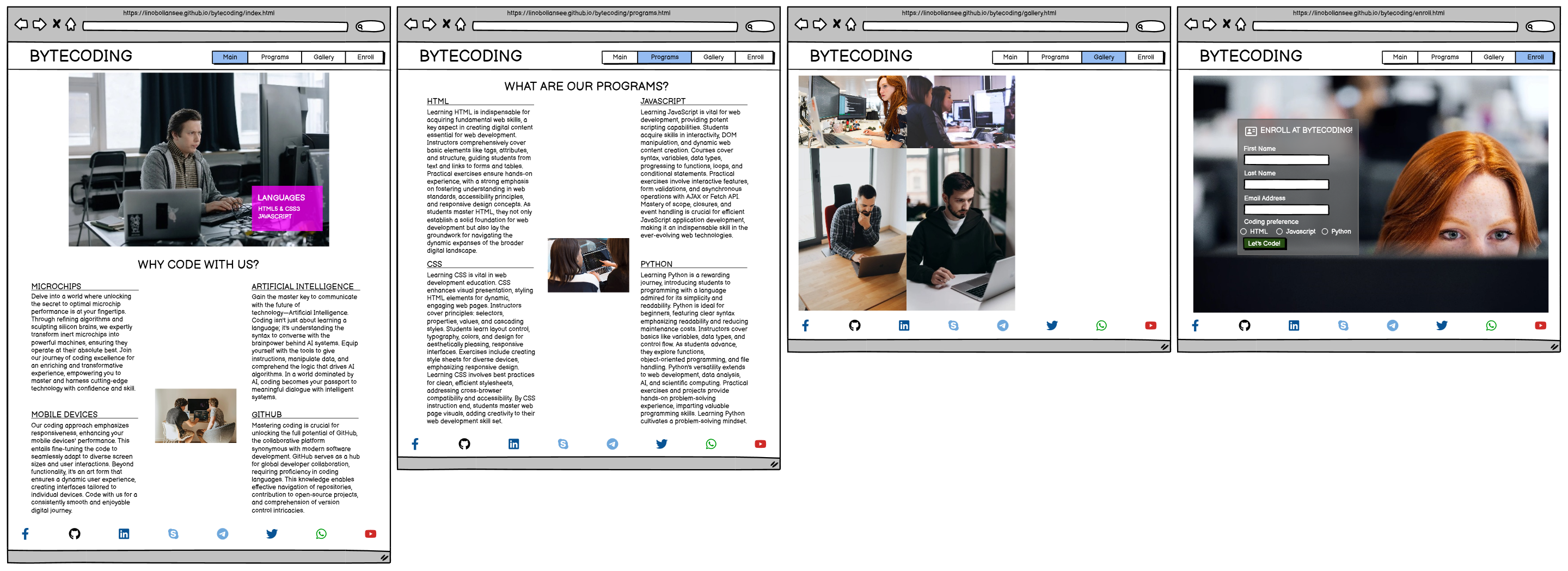
-
Achieving responsiveness in CSS, although crucial for creating a seamless user experience across various devices, poses a considerable challenge. Fine-tuning responsiveness demands a delicate balance between maintaining a visually appealing layout and ensuring optimal functionality on screens of different sizes. Coding CSS that adapts gracefully to diverse screen dimensions, orientations, and resolutions involves intricate adjustments and meticulous attention to detail. The complexity arises from the need to strike a harmonious equilibrium, where design elements seamlessly reconfigure themselves without sacrificing clarity or coherence. The challenge lies not only in addressing the technical aspects but also in anticipating and accommodating the diverse ways users interact with content. In essence, mastering responsiveness in CSS requires a nuanced understanding of design principles and a skillful navigation of the intricate landscape of web development.
-
Offline backups are strongly recommended as a crucial component of a comprehensive data management strategy, acknowledging the inherent imperfections in any system. Despite advancements in technology and robust security measures, unforeseen events such as system failures, cyberattacks, or natural disasters can pose a threat to data integrity. No system is entirely foolproof, and having offline backups serves as a safeguard against potential data loss. These backups, stored on physical devices or disconnected from the network, act as a fail-safe mechanism, ensuring that critical information can be retrieved even in the face of catastrophic events. By maintaining offline backups, an extra layer of resilience is added to data infrastructure, mitigating the risks associated with unforeseen circumstances and reinforcing the principle that a well-rounded data protection strategy considers both online and offline measures.
-
It is highly recommended to actively participate in code experimentation as a dynamic strategy to uncover optimal coding solutions. This involves iteratively testing various implementations or configurations to identify the most efficient and effective solution for a particular problem. Code experimentation provides developers with the opportunity to explore a spectrum of possibilities, gaining valuable insights into the strengths and weaknesses of different approaches. This iterative process supports the enhancement of developers' comprehension of the problem domain, enabling them to refine their code for improved performance and functionality.
-
To enhance clarity and maintainability, it's recommended to consistently follow a standardized file naming convention. When naming files, use lowercase letters exclusively and avoid uppercase letters to prevent potential case sensitivity issues across different platforms. Instead of spaces, choose hyphens to separate words within filenames, promoting readability and ensuring compatibility with various systems. Prioritize the use of clear and descriptive filenames that succinctly convey the purpose or content of the file. This approach fosters a more organized and intuitive project structure, facilitating collaboration among team members through a transparent and comprehensible file naming scheme. Adopting these conventions contributes to a streamlined development process and promotes good coding practices throughout the project lifecycle.
-
Recognizing the impact of fatigue on the quality of work, particularly in intricate tasks like coding or project development, is crucial. When operating in a tired state, the likelihood of errors increases, given compromised cognitive functions and diminished attention to detail. Fixing these errors later in the development process can be challenging, potentially causing delays and inefficiencies. Therefore, prioritizing quality over quantity and refraining from working when fatigued is advisable. Maintaining a healthy work-life balance, taking breaks, and ensuring adequate rest are essential practices to optimize performance and contribute to successful, error-free project outcomes.